
The planning approach

From scattered retirement questions to one plan you can use.

You may already know the pieces of a retirement plan. The harder part is deciding what matters most, which tradeoffs are worth making, and when to act. Retire With Swan helps you bring those choices together into one clear retirement story—and a Blueprint you can use.

From scattered questionsTo one clear Blueprint
Your questions
  • Can I retire?
  • When should I claim?
  • How much can I spend?
  • Which account pays first?
  • What if life changes?
  • What happens to my family?
The missing story What matters first?
  • Priorities
  • Tradeoffs
  • Timing
Swan Song + G.R.A.C.E.
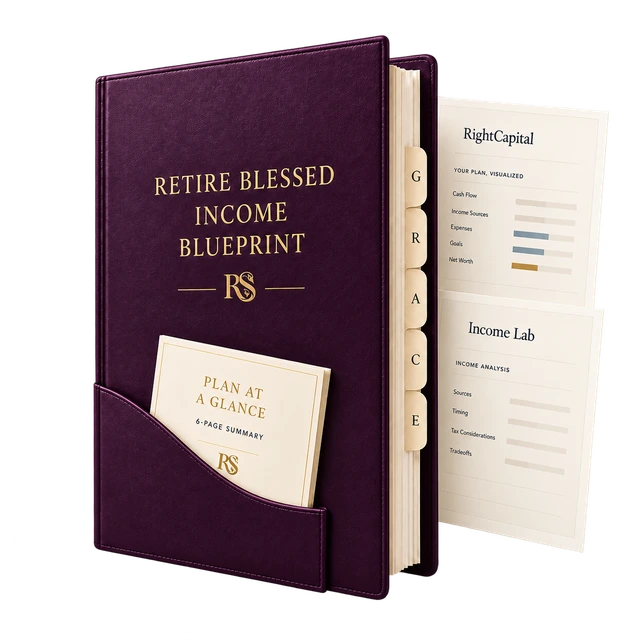
Retire Blessed Income Blueprint binder with its Plan at a Glance summary and supporting planning reports Your Blueprint One plan you can use

Why the questions feel hard

The questions are hard because they touch.

Take Social Security. A choice that looks isolated can change the work of the whole plan.

One connected decision Claim Social Security at 64—or wait?
  1. GIncome

    Income begins sooner, but the monthly check—and the survivor benefit tied to it—remain smaller for life.

  2. RReserves

    The bridge may be shorter, changing how much near-term margin the household needs.

  3. AAssets

    The timing changes how much the portfolio must provide and for how long.

  4. CTaxes

    The income pattern can change taxes across years and, in some cases, Medicare premiums.

  5. EFamily

    Survivor income and what may remain for family can change with the claiming choice.

This is not five separate questions. The answer depends on what the rest of the household needs that one choice to do.

The ordering conviction

So the work needs an order.

More information cannot choose the priority. Someone still has to decide what must hold before the next decision deserves attention.

The principle

Here is where I begin.

Daily bread first.
Provision before optimization.
Margin before risk.

Retirement is not merely a reward. It is a small chance to better align your life. That work is difficult when daily bread is still uncertain. Secure the bread, and the rest of the plan gets to be about your life.

The name G.R.A.C.E. is not an accident. I am a Christian. God’s grace gives me the freedom to worship and honor Him. That conviction shapes how I think about planning: secure provision and margin so a household has greater freedom to live its values and use its time well.

The G.R.A.C.E. examinationBegin at G. Move forward in order. ↓
  1. GGuaranteed IncomeCoordinate reliable income for daily bread.
  2. RReserves and InsuranceBuild protection and margin for disruption.
  3. AAsset Growth and IncomeGive the portfolio a defined job.
  4. CComprehensive Tax PlanningCoordinate taxes across years.
  5. EEstate and LegacyCarry the household’s intentions forward.

The order is consistent. The emphasis belongs to the household.

Same examination. Different emphasis.

The same order can lead to a different answer.

G.R.A.C.E. begins at G for every household. The first unresolved priority determines where the work must place its weight.

One examinationG → R → A → C → E
Illustrative household 01 Eighteen months from retirement

Meaningful savings are in place, but the pension choice, Social Security timing, and essential monthly spending have not yet been brought together.

GRACE
First unresolved priority G · Build the income foundation.

Define daily bread and the remaining income gap before deciding how much the reserve, portfolio, taxes, or estate plan must carry.

Illustrative household 02 Three years into retirement

Pension and Social Security cover everyday spending. The reserve is in place, and the portfolio already has a defined income job.

GRACE
First unresolved priority C · Coordinate the tax window.

Future required distributions, planned giving, and the surviving spouse’s tax picture now deserve attention without disturbing the earlier foundation.

Illustrative households, not actual client examples or personal recommendations. The framework supplies the order; the household’s facts and purpose determine the emphasis.

The finish line

There is a point where your plan is complete.

I call that finish the Enough Line. The emphasis may differ by household, but the examination ends in the same place: every part of the plan has a clear answer.

Below the lineMore money can close real gaps and strengthen the plan.

Above the lineThe next dollar is no longer needed to close a gap. It can be given a different purpose.

So, what’s my number? It is what it takes to complete this structure—not a target that keeps moving forever.

The completion testThe Enough Line
  1. G
    Daily bread is covered.

    Income is built to last as long as you do.

  2. R
    Named risks are funded.

    Reserves or insurance protect against disruption.

  3. A
    The portfolio has a job.

    Clear rules govern what it can provide each year.

  4. C
    Taxes are coordinated.

    The years ahead are planned together.

  5. E
    Your intentions are written.

    You can say them clearly while they are yours to shape.

The whole plan holds. A 30% market drop would not force a change in daily life.

All five answers hold togetherThe Enough Line

Complete does not mean frozen. Once the plan is complete, the work shifts to recording it and keeping it current.

Thinking you can hold

The reasoning becomes something you can hold.

The Household Decision Record shows how the household moved from what it knows to what it will do. The Blueprint keeps that reasoning with the plan.

Household Decision Record
  1. 01Current evidence

    Facts, sources, and dates

  2. 02Assumptions

    Unknowns and modeled inputs

  3. 03Tradeoffs

    Options and dependencies

  4. 04Decision rule

    The household-specific why

  5. 05Decision + action

    Choice, owner, timing, and proof

The written result
Retire Blessed Income Blueprint binder with its Plan at a Glance summary and supporting planning reports The Retire Blessed Income Blueprint

One place for the household’s decisions, reasoning, actions, responsibilities, and review conditions.

The Swan Song System

A simple cadence keeps the plan current.

The judgment is not improvised each time. The same four movements keep the facts, decisions, work, and future changes connected.

  1. 01EvidenceGet Organized
  2. 02Decision orderSolve With G.R.A.C.E.
  3. 03Owned workAssign and Execute
  4. 04Future changeMonitor and Manage

One door

Start with the question in front of you.

Bring the decision you are trying to solve. We will use a short conversation to decide whether Retire With Swan is the right next step.

Schedule a Swan Fit Call